Every year, somebody's laptop is stolen, an external drive stops spinning, or a cloud account gets locked - and years of photos vanish with it. The fix is boring, cheap and takes an afternoon: the 3-2-1 backup rule.
This guide explains the rule in plain English, shows a setup for families and one for professionals, and makes sure your photos stay easy to search.
The 3-2-1 rule
| Number | Means | Why |
|---|---|---|
| 3 copies | The original + 2 backups | One copy is no copy |
| 2 kinds of storage | e.g. computer + external drive | Different things fail differently |
| 1 off-site | A drive elsewhere or a cloud backup | Fire, flood and theft hit one place |
0 hours a year spent looking for files - with a search that takes a second, that is about 0 working days back.
What actually destroys photos
- Drive failure - every drive eventually fails; old ones fail more often.
- Theft and accidents - laptops get stolen, drives get dropped.
- Mistakes - deleting the wrong folder, formatting the wrong card.
- Ransomware - malware that locks files.
- Account problems - losing access to a cloud account.
- Fire, flood - everything in one place goes at once.
A setup for families (about an afternoon)
| Tool | Windows | Mac |
|---|---|---|
| Automatic local backup | File History | Time Machine |
| Manual copy | Copy folder to drive | Copy folder to drive |
| Off-site | Cloud backup service or drive at relative's | Same |
A setup for photographers and studios
| Copy | Where | How often |
|---|---|---|
| Working | Fast internal or external SSD | Live |
| Archive | Large external drive or NAS | After every shoot |
| Off-site | Cloud backup or rotated drives | Daily/weekly |
Sync is not backup
Cloud sync (OneDrive, iCloud Drive, Dropbox, Google Drive) mirrors changes - including deletions. Delete a folder by mistake and it disappears everywhere. Many services keep deleted files for a while, but don't count on sync as your only backup. Use a real backup with version history for your off-site copy.
Keep your library searchable
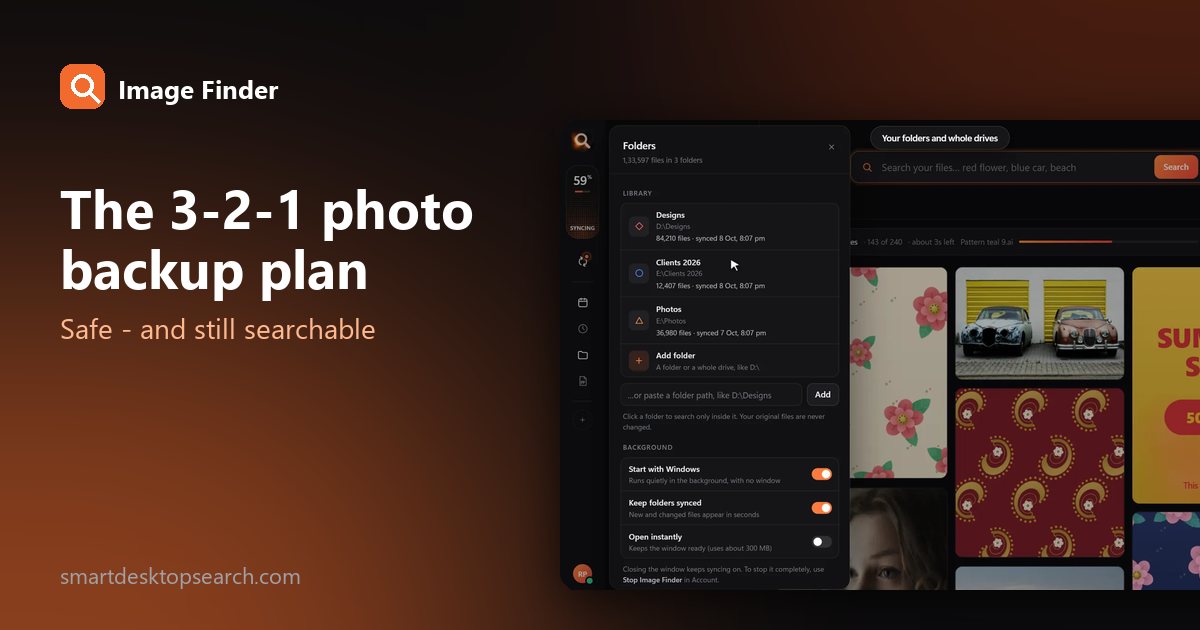
Backups are the safety net. Your main copy is the one you use - so make it searchable. Add it to Image Finder and every photo can be found by moment, face, color or the words in it. Previews are kept, so even when a backup drive is unplugged you can see what's on it.
Check your backups are real
Choosing drives that last
| Choice | Recommendation |
|---|---|
| Type | HDD for big, cheap backups; SSD for speed and portability |
| Size | At least twice your library size to grow into |
| Brand | Well-known brands with good warranties |
| Number | At least two - never rely on one |
| Replacement | Plan to replace backup drives every 4-5 years |
Off-site options compared
| Option | Pros | Cons |
|---|---|---|
| Cloud backup service | Automatic, off-site | Monthly cost; first upload is slow |
| Drive at a relative's or office | One-time cost, private | Manual swaps |
| Cloud storage (sync) | Easy | Not a true backup on its own |
The best off-site copy is the one you'll actually keep up to date. If you won't swap drives, choose an automatic service.
Encryption
If a backup drive leaves your home, encrypt it:
- Windows: BitLocker (in Windows Pro editions) or a drive with hardware encryption.
- Mac: Finder can encrypt a drive (right-click > Encrypt), or format it with encryption in Disk Utility.
Write the password down and keep it somewhere safe - a lost password means a lost backup.
Ransomware protection
Ransomware encrypts every file it can reach - including connected backup drives. Protect yourself:
- Keep at least one backup disconnected most of the time.
- Use backup software with version history so you can restore older copies.
- Keep your computer updated and be careful with email attachments.
Phone photos: the forgotten copy
Phone photos are often the most precious and the least backed up. Make copying phone photos to your main library part of your monthly routine - then they're covered by all three copies.
Restoring: practice once
A backup you've never restored from is a hope, not a plan. Once a year, restore one folder from your backup to a test location and open the files. If it works, you'll know exactly what to do on a bad day.
Questions people ask
What is the 3-2-1 backup rule?
Three copies of your data, on two kinds of storage, with one copy off-site.
Is cloud storage a backup?
Cloud backup with version history is. Simple sync (mirroring a folder) is not a full backup on its own.
How often should I back up photos?
Automatically if possible; at least monthly, and after every important event or shoot.
How long do external drives last?
Often 3-5 years of regular use. Replace old drives and keep more than one copy.
Windows and Mac. Private, offline, no subscription.